Loading...
Searching...
No Matches
Capability< ActionServerT > Class Template Reference
Lifecycle node that advertises a single action as a "capability". More...
#include <capability.hpp>
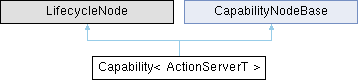
Inheritance diagram for Capability< ActionServerT >:
Public Types | |
| using | CallbackReturn = rclcpp_lifecycle::node_interfaces::LifecycleNodeInterface::CallbackReturn |
| Lifecycle transition result type shared with rclcpp_lifecycle. | |
| using | ActionServerBaseT = ActionServerBase<typename ActionServerT::ActionType> |
| The ActionServerBase<...> specialization backing this capability. | |
| Public Types inherited from CapabilityNodeBase | |
| using | SharedPtr = std::shared_ptr<CapabilityNodeBase> |
| Shared pointer to a CapabilityNodeBase. | |
| using | CallbackReturn = rclcpp_lifecycle::node_interfaces::LifecycleNodeInterface::CallbackReturn |
| Lifecycle transition result type shared with rclcpp_lifecycle. | |
Public Member Functions | |
| Capability (const std::string &capability_name, const rclcpp::NodeOptions &options=rclcpp::NodeOptions()) | |
| Constructs the capability node. | |
| ActionServerBaseT::SharedPtr | get_action_server () const noexcept |
| The action server backing this capability. | |
| const std::string & | get_capability_name () const noexcept override |
| The capability identity field published on /capabilities and /capabilities_status. | |
| const std::string & | get_robot_name () const noexcept override |
| This node's namespace, without the leading '/' (empty if none), e.g. | |
| const std::string & | get_resolved_action_name () const noexcept |
| Fully-qualified name of the action this capability exposes, e.g. | |
| CallbackReturn | configure_node () override |
| Drive the underlying lifecycle node from UNCONFIGURED to INACTIVE. | |
| CallbackReturn | activate_node () override |
| Drive the underlying lifecycle node from INACTIVE to ACTIVE. | |
| CallbackReturn | deactivate_node () override |
| Drive the underlying lifecycle node from ACTIVE to INACTIVE. | |
| CallbackReturn | cleanup_node () override |
| Drive the underlying lifecycle node from INACTIVE to UNCONFIGURED. | |
| CallbackReturn | shutdown_node () override |
| Drive the underlying lifecycle node to FINALIZED, from whatever state it is currently in. | |
| uint8_t | get_current_state_id () const override |
| The underlying lifecycle node's current state id. | |
| rclcpp::node_interfaces::NodeBaseInterface::SharedPtr | get_node_base_interface () override |
| So a Deployment can add the underlying node to its shared executor without knowing its concrete type. | |
Protected Member Functions | |
| CallbackReturn | on_configure (const rclcpp_lifecycle::State &previous_state) override |
| Reads capabilities_file and configures the contained ActionServerT. | |
| CallbackReturn | on_activate (const rclcpp_lifecycle::State &previous_state) override |
| Publishes the capability description and starts the status heartbeat. | |
| CallbackReturn | on_deactivate (const rclcpp_lifecycle::State &previous_state) override |
| Stops the status heartbeat. | |
| CallbackReturn | on_cleanup (const rclcpp_lifecycle::State &previous_state) override |
| Releases the resources acquired in on_configure(). | |
| CallbackReturn | on_shutdown (const rclcpp_lifecycle::State &previous_state) override |
| Stops the status heartbeat if still running. | |
Detailed Description
template<typename ActionServerT>
class easyfleet_core::Capability< ActionServerT >
class easyfleet_core::Capability< ActionServerT >
Lifecycle node that advertises a single action as a "capability".
Capability<ActionServerT> is a rclcpp_lifecycle::LifecycleNode that:
- owns an instance of ActionServerT (a concrete subclass of ActionServerBase<ActionType>, constructed as ActionServerT(rclcpp_lifecycle::LifecycleNode &, const std::string &)), exposed through its ActionServerBase<ActionType>::SharedPtr base type;
- on on_activate, reads the file named by the capabilities_file string parameter and publishes it, together with its own runtime identity (namespace and fully-qualified action name), as an easyfleet_interfaces/CapabilityDescription on the reliable, transient-local /capabilities topic, so late subscribers still get it;
- while active, publishes an easyfleet_interfaces/CapabilityStatus heartbeat once a second on /capabilities_status.
ActionServerT must publicly inherit ActionServerBase<SomeActionType> and be constructible as ActionServerT(LifecycleNode &, const std::string &).
The robot/capability/action_name identity published on both topics is resolved from this node's actual namespace at construction time, so a capability launched under namespace robot1 announces itself as such without any code changes – this is what lets a control center tell apart, say, robot1's and robot2's navigation capabilities.
Also implements CapabilityNodeBase, so a Robot/Deployment that doesn't know (and doesn't need to know) ActionServerT can still drive this instance's lifecycle and add its node to an executor – see capability_node_base.hpp and capability_factory.hpp.
Constructor & Destructor Documentation
◆ Capability()
template<typename ActionServerT>
|
explicit |
Constructs the capability node.
- Parameters
-
capability_name Used as the node name, the action name of the contained action server, and the capability identity field. options Forwarded to the underlying LifecycleNode.
Member Function Documentation
◆ activate_node()
template<typename ActionServerT>
|
overridevirtual |
Drive the underlying lifecycle node from INACTIVE to ACTIVE.
- Returns
- The resulting lifecycle transition outcome.
Implements CapabilityNodeBase.
◆ cleanup_node()
template<typename ActionServerT>
|
overridevirtual |
Drive the underlying lifecycle node from INACTIVE to UNCONFIGURED.
- Returns
- The resulting lifecycle transition outcome.
Implements CapabilityNodeBase.
◆ configure_node()
template<typename ActionServerT>
|
overridevirtual |
Drive the underlying lifecycle node from UNCONFIGURED to INACTIVE.
- Returns
- The resulting lifecycle transition outcome.
Implements CapabilityNodeBase.
◆ deactivate_node()
template<typename ActionServerT>
|
overridevirtual |
Drive the underlying lifecycle node from ACTIVE to INACTIVE.
- Returns
- The resulting lifecycle transition outcome.
Implements CapabilityNodeBase.
◆ get_action_server()
template<typename ActionServerT>
|
noexcept |
The action server backing this capability.
- Returns
- The contained ActionServerT, through its ActionServerBaseT::SharedPtr base type.
◆ get_capability_name()
template<typename ActionServerT>
|
overridevirtualnoexcept |
The capability identity field published on /capabilities and /capabilities_status.
- Returns
- The capability identity field published on /capabilities and /capabilities_status.
Implements CapabilityNodeBase.
◆ get_current_state_id()
template<typename ActionServerT>
|
overridevirtual |
The underlying lifecycle node's current state id.
- Returns
- The underlying lifecycle node's current state id (one of the lifecycle_msgs::msg::State::PRIMARY_STATE_* constants).
Implements CapabilityNodeBase.
◆ get_node_base_interface()
template<typename ActionServerT>
|
overridevirtual |
So a Deployment can add the underlying node to its shared executor without knowing its concrete type.
- Returns
- The underlying node's base interface.
Implements CapabilityNodeBase.
◆ get_resolved_action_name()
template<typename ActionServerT>
|
noexcept |
Fully-qualified name of the action this capability exposes, e.g.
"/robot1/navigation". This is the action_name identity field published on /capabilities and /capabilities_status.
- Returns
- The resolved, fully-qualified action name.
◆ get_robot_name()
template<typename ActionServerT>
|
overridevirtualnoexcept |
This node's namespace, without the leading '/' (empty if none), e.g.
"robot1". This is the robot identity field published on /capabilities and /capabilities_status.
- Returns
- This node's resolved robot name.
Implements CapabilityNodeBase.
◆ on_activate()
template<typename ActionServerT>
|
overrideprotected |
Publishes the capability description and starts the status heartbeat.
- Parameters
-
previous_state State this node is transitioning from.
- Returns
- CallbackReturn::SUCCESS on success, CallbackReturn::FAILURE otherwise.
◆ on_cleanup()
template<typename ActionServerT>
|
overrideprotected |
Releases the resources acquired in on_configure().
- Parameters
-
previous_state State this node is transitioning from.
- Returns
- CallbackReturn::SUCCESS on success, CallbackReturn::FAILURE otherwise.
◆ on_configure()
template<typename ActionServerT>
|
overrideprotected |
Reads capabilities_file and configures the contained ActionServerT.
- Parameters
-
previous_state State this node is transitioning from.
- Returns
- CallbackReturn::SUCCESS on success, CallbackReturn::FAILURE otherwise.
◆ on_deactivate()
template<typename ActionServerT>
|
overrideprotected |
Stops the status heartbeat.
- Parameters
-
previous_state State this node is transitioning from.
- Returns
- CallbackReturn::SUCCESS on success, CallbackReturn::FAILURE otherwise.
◆ on_shutdown()
template<typename ActionServerT>
|
overrideprotected |
Stops the status heartbeat if still running.
- Parameters
-
previous_state State this node is transitioning from.
- Returns
- CallbackReturn::SUCCESS on success, CallbackReturn::FAILURE otherwise.
◆ shutdown_node()
template<typename ActionServerT>
|
overridevirtual |
Drive the underlying lifecycle node to FINALIZED, from whatever state it is currently in.
- Returns
- The resulting lifecycle transition outcome.
Implements CapabilityNodeBase.
The documentation for this class was generated from the following files:
- easyfleet_core/include/easyfleet_core/capability.hpp
- easyfleet_core/include/easyfleet_core/detail/capability_impl.hpp