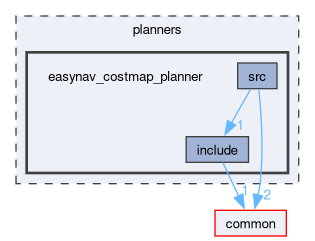
Directories | |
| include | |
| src | |
Detailed Description
easynav_costmap_planner
"" "" "" "" "" "" "" ""
Description
A planner plugin implementing a standard A* path planner over a Costmap2D representation. It reads the dynamic costmap, goal list, and robot pose from NavState and publishes a computed path as a nav_msgs/Path message.
Authors and Maintainers
- Authors: Intelligent Robotics Lab
- Maintainers: Francisco Martín Rico fmric.nosp@m.o@gm.nosp@m.ail.c.nosp@m.om
Supported ROS 2 Distributions
| Distribution | Status |
|---|---|
| humble |  |
| jazzy |  |
| kilted |  |
| rolling |  |
Plugin (pluginlib)
- Plugin Name: easynav_costmap_planner/CostmapPlanner
- Type: easynav::CostmapPlanner
- Base Class: easynav::PlannerMethodBase
- Library: easynav_costmap_planner
- Description: A default Costmap2D-based A* path planner implementation.
Parameters
All parameters are declared under the plugin namespace, i.e., /<node_fqn>/easynav_costmap_planner/CostmapPlanner/....
| Name | Type | Default | Description |
|---|---|---|---|
| <plugin>.cost_factor | double | 2.0 | Scaling factor applied to costmap cell values to compute traversal costs. Higher values make high-cost cells much less attractive. |
| <plugin>.inflation_penalty | double | 5.0 | Extra penalty added to inflated/near-obstacle cells to push paths away from obstacles. |
| <plugin>.heuristic_scale | double | 1.0 | Scaling factor applied to the A* heuristic term. Controls the trade-off between following the cheapest route vs. going more directly. |
| <plugin>.continuous_replan | bool | true | If true, re-plans continuously as the map/goal changes; if false, plans once per request. |
Effect of cost_factor
The planner uses a per-step traversal cost:
$$ g_{\text{new}} = g_{\text{current}} + \text{step_cost} \cdot \left(1 + \text{cost_factor} \cdot \frac{\text{cell_cost}}{\text{LETHAL_OBSTACLE}}\right) $$
- Low cost_factor (e.g. 1–2):
- Cell cost has a modest influence; the planner is closer to a pure geometric shortest-path search.
- Paths may cross moderately expensive regions if that keeps distance short.
- High cost_factor (e.g. 5–10+):
- High-cost cells become very unattractive, so the planner strongly prefers low-cost corridors (e.g. routes or low-inflation areas), even if they are longer.
- Useful when combined with modules that encode preferences as higher costs (such as route managers).
Effect of heuristic_scale
The A* priority is:
$$ f = g + h, \quad h = \text{heuristic_scale} \cdot d_{\text{cells}}(\text{current}, \text{goal}) $$
where $d_{\text{cells}}$ is the Euclidean distance in cell indices (not metric distance, but proportional).
- Decrease heuristic_scale (< 1.0):
- The heuristic term becomes weaker, and A* behaves more like Dijkstra.
- The search explores more alternatives and is guided more strictly by the true accumulated cost $g$.
- This usually makes the planner follow high-cost penalties (e.g. for leaving a route) more faithfully, at the expense of more computation.
- Increase heuristic_scale (> 1.0):
- The heuristic term dominates more, so the planner prefers geometrically direct paths.
- It may still avoid extremely high-cost regions if cost_factor is large, but will be more willing to “cut corners” through slightly more expensive zones.
Typical tuning strategy:
- First, adjust cost_factor so that the costmap properly encodes your preferences:
- Increase it until paths clearly avoid high-cost areas that should be disfavored.
- Then, fine-tune heuristic_scale:
- Start from 1.0.
- If the planner still takes shortcuts that ignore cost differences, consider reducing it slightly (e.g. 0.7–0.9).
- If planning becomes too slow or explores too widely, you can increase it modestly (e.g. 1.2–1.5).
Interfaces (Topics and Services)
Publications
| Direction | Topic | Type | Purpose | QoS |
|---|---|---|---|---|
| Publisher | <node_fqn>/<plugin>/path | nav_msgs/msg/Path | Publishes the computed path from start to goal. | depth=10 |
This plugin does not create subscriptions or services directly; it reads inputs via NavState.
NavState Keys
| Key | Type | Access | Notes |
|---|---|---|---|
| goals | nav_msgs::msg::Goals | Read | Goal list used as planner targets. |
| map.dynamic | Costmap2D | Read | Dynamic costmap used for A* search. |
| robot_pose | nav_msgs::msg::Odometry | Read | Current robot pose used as the start position. |
| path | nav_msgs::msg::Path | Write | Output path to follow. |
TF Frames
| Role | Transform | Notes |
|---|---|---|
| Reads | map -> base_footprint | Requires consistent frames between the costmap and the published path. |
License
Apache-2.0
Generated by
 1.16.1